Wednesday, 19 March 2014
Bearings and loci
Objectives
Bearings
Locus from a fixed point
Constructing a perpendicular bisector
(to find the locus that is equidistant from two points)
Locus from a line
Constructing the bisector of an angle
(to find the locus that is equidistant from two lines)
Bearings
Locus from a fixed point
A locus means a path. 'Loci' is the plural of locus. It shows us the path or region that a point can travel according to certain rules.
The locus of points that are equidistant from two points: Constructing a Perpendicular Bisector
You can find the method by clicking on the image below:Watch the video.
The locus of all points that are equidistant from two lines: Bisecting an angle
We use this method to find the locus of all points that are equidistant from two lines.
Some real world examples of loci
Watch a video of how loci apply in the real world.
Labels:
Grade 8 Maths
Tuesday, 18 March 2014
Graphing and Solving Linear Equations
- The equation of a line
- Solving two simultaneous equations using a graph
- Trial and Improvement method to solve an equation
Linear Equations
Solving two simultaneous equations using a graph
Trial and Improvement method to solve an equation
Using this method we 'guess' the first value x and then try other values until we find one that works. Click the image below for an example:
Labels:
Grade 8 Maths
Monday, 10 March 2014
Tuesday, 4 February 2014
Constructions
- Constructing the perpendicular bisector of a line
- Finding the perpendicular from a point to a line
- Bisecting an angle
Watch the video.
- Finding the perpendicular from a point to a line
- Bisecting an angle
Constructing a Perpendicular Bisector
You can find the method by clicking on the image below:Watch the video.
Bisecting an angle
Labels:
Grade 8 Maths
Sunday, 2 February 2014
Angles of Polygons
Interior and Exterior Angles
Exterior Angles of a Polygon
Remember, a polygon is any shape that has 3 or more straight sides (no curves).
Click on the hexagon above to see that:
The exterior angles of any polygon add up to 360°
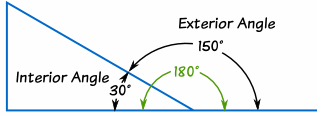
Interior Angles
90° + 60° + 30° = 180° | 80° + 70° + 30° = 180° |
It works for this triangle!
|
Let's tilt a line by 10° ...
It still works, because one angle went up by 10°, but the other went down by 10°
|
The Interior Angles of a Triangle add up to 180°
| The interior angles in this triangle add up to 180° (90°+45°+45°=180°) | ... and for this square they add up to 360° ... because the square can be made from two triangles! |
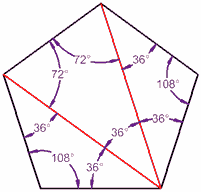
Because a pentagon has three triangles, the sum of the interior angles add up to 3x180° = 540°
In general:
The sum of the interior angles of a polygon that has n sides, is:
(n-2) x 180°
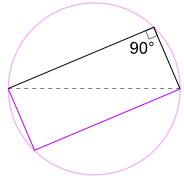
Triangles in a circle:
The triangle drawn on the diameter of a circle is always
a right angled triangle
Labels:
Grade 8 Maths
Subscribe to:
Posts (Atom)