Sunday, 10 November 2013

Graphs, gradients and lines

Objectives:

  • Drawing curved graphs

  • Calculate the gradient and intercepts of a line

  • Solving equations graphically


Straight line graphs: 

This link shows how a line changes as you change the values.

Curved Graphs: 

Have a look here to see how changing the constants in an equation changes the shape of the graph.

Homework:

Page 56    Ex 11  Q: 5

Page 57    Ex 12  Q: 1 i,j; Q2

Page 59    Ex 14  Q: 9, 10, 15, 23

Page 62    Ex 16  Q: 4


Friday, 8 November 2013

Equations


Objectives:

-Solving Equations: Variable on both sides; fractions; geometrical;

-Drawing linear graphs

 Solving Equations:


Homework:

Page 48 Ex 4 Q: 16, 22,28

Page 48 Ex 5 Q: 13, 16, 19

Page 49 Ex 6 Q: 21, 26, 31

Page 49 Ex 7 Q: 5

Page 50 Ex 8 Q: 5, 12

Page 51 Ex 9 Q: 5, 7, 11

Page 54 Ex 10 Q:11

Wednesday, 6 November 2013

Researching for your website

Environmental Awareness

In this week's class you will be researching some aspect of Environmental Awareness for your website. 

Read the following page on how to research information on the internet. Don't forget that you can also read books and other reference books, e.g. an encyclopaedia. Online encyclopedias include:

•Encyclopedia Britannica – www.britannica.com
•Encarta – www.encarta.msn.com 
Have a look a the sample website research here.


Use the worksheets to write out your research, or you can do it on your computer using the sheets.


>>>>>Here are some sites to get you started:

Tuesday, 5 November 2013

Data & Storage Media (Unit 3)

Objectives:

(a) describe common backing storage media (including magnetic tapes, hard discs, all forms of CD and DVD, memory sticks, flash memory) and their associated devices
(b) identify typical uses of the storage media, including types of access (e.g. serial/sequential, direct/random) and access speeds
(c) describe the comparative advantages and disadvantages of using different backing storage media
(d) define the term backup and describe the need for taking backups
(e) describe the difference between main/internal memory and backing storage, stating the relative benefits of each in terms of speed and permanence


Main information:


You can also look at:


Quick Review is available here:


Binary Code

Binary just means '0' and '1', the language computers understand. Our alphabet is converted to binary using "ASCII" code (American Standard Code for Information Interchange). Click here to find out more.
You can use this website to convert text to binary.


Saturday, 2 November 2013

Letters as numbers and solving equations

Objectives:

  • Link numbers to letters. 

  • Solve equations: know that what we do on one side of the equation we must do on the other.

  • Write mathematical sentences.


Linking numbers to letters.


Try the quiz:

Tuesday, 29 October 2013

Input & Output Devices

Break up into groups, use the internet, ictlounge.com or see the files at http://sdrv.ms/1irTRTL
to research each device.
  • State whether each device is an Input Device, Output Device or a Sensor. 
  • Give a brief explanation how it operates and what it is typically used for. 
  • List some advantages and disadvantages.
  • Any other information of interest.

Present back to the class and be prepared to answer questions.


Monday, 28 October 2013

Angles, Lines and Polygons

Objectives:
To know that the angles of a triangle add up to 180°
Angle properties of parallel lines
To know that the sum of the interior and exterior angles of quadrilateral add up to 360°
Tangents and triangles in a semi-circle


The angles of a triangle add up to 180°


Angle properties of parallel lines


Interior Angles of Polygons

An Interior Angle is an angle inside a shape.

Triangles

The Interior Angles of a Triangle add up to 180°

90° + 60° + 30° = 180°

80° + 70° + 30° = 180°

It works for this triangle!


Let's tilt a line by 10° ...
It still works, because one angle went up by 10°, but the other went down by 10°

Quadrilaterals (Squares, etc)

(A Quadrilateral has 4 straight sides)

90° + 90° + 90° + 90° = 360°

80° + 100° + 90° + 90° = 360°

A Square adds up to 360°


Let's tilt a line by 10° ... still adds up to 360°!

The Interior Angles of a Quadrilateral add up to 360°

Because there are Two Triangles in a Square

The interior angles in this triangle add up to 180°

(90°+45°+45°=180°)
... and for this square they add up to 360°
... because the square can be made from two triangles!


>>>>>>>>>>>>>>>>>>>>>>>>>>>>>>>>>>>>>>>>>>>>>>>>>>>>>>>>>>>>>>>>>>>>

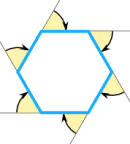
Exterior angles of a polygon add up to 360


Names of polygons


>>>>>>>>>>>>>>>>>>>>>>>>>>>>>>>>>>>>>>>>>>>>>>>>>>>>>>>>>>>>>>>>>>>>>>>

The angle between the tangent and radius is 90°

image: a tangent
A tangent to a circle is a line which just touches the circle.
image: circle with solid circle inside placed central point, a line represents radius placed at 90 degrees , straight-line off the left edge of circle.
Remember:
A tangent is always at right angles to the radius where it touches the circle.

>>>>>>>>>>>>>>>>>>>>>>>>>>>>>>>>>>>>>>>>>>>>>>>>>>>>>>>>>>>>>>>>>>

The triangle drawn on the diameter of a circle is always a right angles triangle


We could also rotate the shape around 180° to make a rectangle!
It is a rectangle, because all sides are parallel, and both diagonals are equal.
And so its internal angles are all right angles (90°).